Solid Waste Collection: A Complete Operations Guide
Explore this complete guide to solid waste collection operations. Learn about systems, equipment, KPIs, and how route optimization technology can reduce costs.
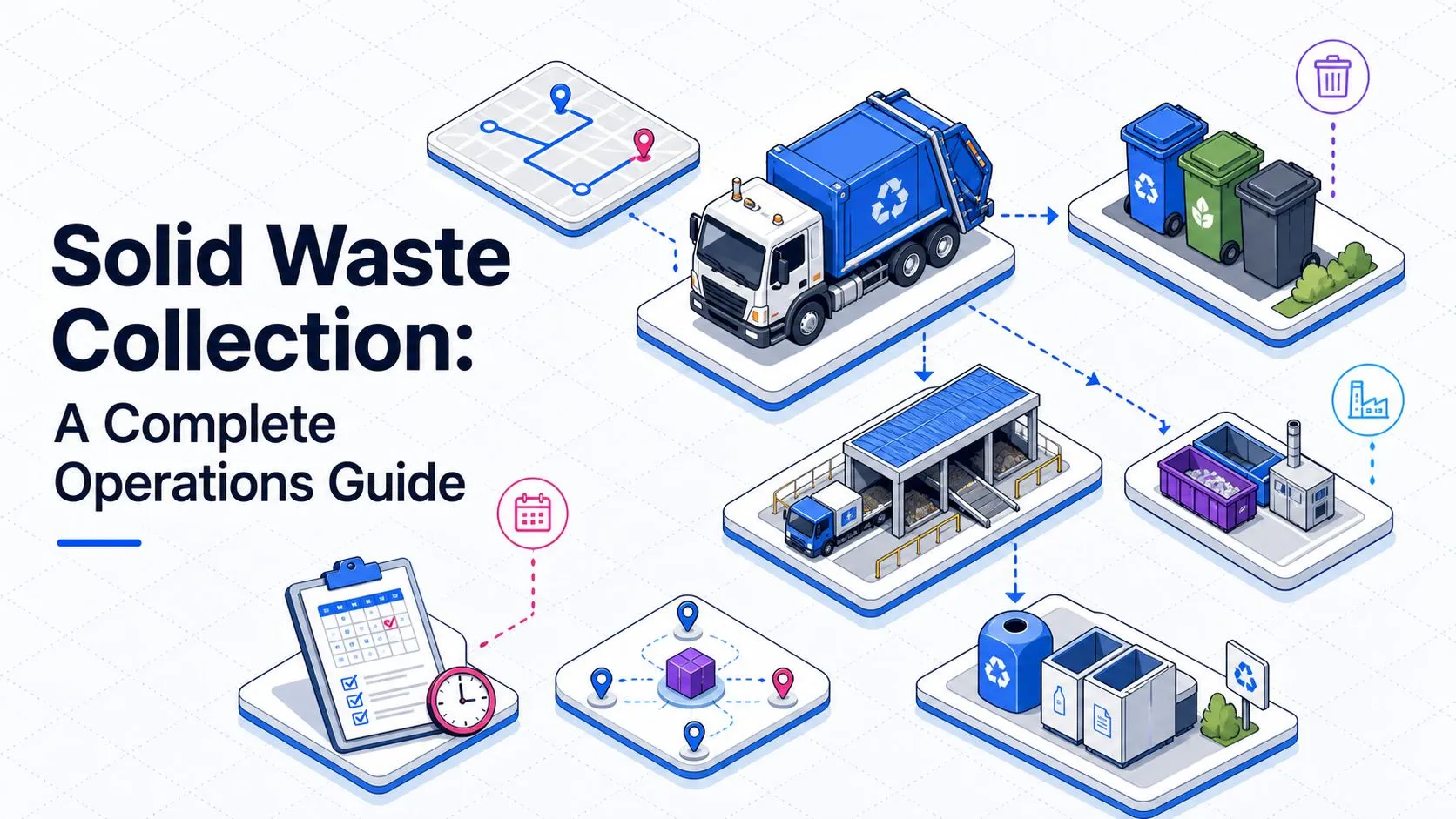
2.56 billion tonnes of waste were generated worldwide in 2022, according to the World Bank estimate cited by the U.S. EPA’s national overview of materials, waste, and recycling. That number changes how an operations manager should think about solid waste collection. This isn’t a background municipal service. It’s a large, daily logistics operation with strict time windows, safety exposure, asset constraints, and very little room for error.
Most new managers enter waste collection thinking the hard part is getting trucks out on time. That matters, but the actual job is harder. You’re balancing service reliability, route density, disposal access, driver behavior, container placement, contamination, maintenance, and regulation at the same time. If any one of those fails, the route fails with it.
Good solid waste collection looks simple from the outside. Residents put material out. Trucks arrive. Waste disappears. In practice, every stop is a decision point, and every route reflects hundreds of upstream choices.
Table of Contents
- The Growing Challenge of Managing Waste
- Defining Solid Waste and Collection Types
- Comparing Key Waste Collection Systems
- Essential Equipment and Vehicle Considerations
- Daily Operations Workflows and Safety Protocols
- Measuring Performance with Waste Collection KPIs
- How Route Optimization Tech Boosts Efficiency
- The Future of Smart Waste Collection
The Growing Challenge of Managing Waste
A useful baseline comes from a 2022 reassessment of global municipal solid waste. It estimated that MSW rose from 1.50 to 2.22 billion tonnes in 2004 to 2.29 to 3.13 billion tonnes in 2019, an increase of roughly 28.8% to 53.4%, and found that almost one-third of global MSW is not collected at all, according to the study in Environmental Science and Pollution Research. For an operations manager, those numbers matter because they point to two separate problems. One is efficiency. The other is service coverage.
If you only focus on truck productivity, you miss the field conditions. Many systems don’t just struggle with route efficiency. They struggle to reach the waste stream in the first place. Narrow streets, poor road conditions, weak transfer infrastructure, and irregular set-out behavior all turn collection into an access problem before it becomes a routing problem.
Practical rule: Collection is the control point. If waste isn’t collected reliably, every downstream target fails, including recycling, organics diversion, cost control, and public trust.
That’s why solid waste collection should be managed like a network, not a series of truck runs. The network starts at the household or business, moves through container design and set-out rules, then into route planning, vehicle selection, tipping or transfer, and post-route reporting. Weakness at any point shows up later as missed pickups, overloaded vehicles, long dwell times, customer complaints, or unsafe improvisation by crews.
A new operations manager usually gets measured on visible outcomes first. Routes completed. Complaints closed. Overtime contained. Those are valid concerns, but they’re lagging indicators. The stronger approach is to tighten the basics early. Standardize stops, reduce avoidable exceptions, and make sure the collection model fits the physical environment.
Defining Solid Waste and Collection Types
Waste classification sets the operating model. It determines container choice, lift method, collection frequency, crew instructions, transfer options, and what can legally enter each load.

Classification drives operations
A new operations manager should treat waste categories as route design inputs, not office labels. Once material is defined correctly at the source, the rest of the system gets easier to control. Containers match the stream, drivers know what they are allowed to take, contamination rules are clearer, and disposal or recovery plans can be scheduled with fewer surprises.
The scale of the municipal stream in the United States is already large, as noted earlier. That matters operationally because collection has to sort service demand into workable categories before disposal, processing, or diversion can happen. If classification is loose, every downstream step gets more expensive.
The field impact is immediate. A front-load route built for commercial refuse should not absorb loose construction debris. A residential route designed for cart tipping will break down quickly if crews spend half the shift dealing with side waste, bagged yard material, or prohibited items left at the curb. Good classification protects route time.
The main streams an operations manager must separate
Municipal solid waste is the recurring daily stream from households, retail, offices, schools, and similar generators. For most collection teams, this is the base service. It often includes separate programs for trash, recycling, and sometimes organics. The operational challenge is consistency. Stop counts are high, exceptions are frequent, and contamination can spread across an entire route if set-out rules are weak.
Construction and demolition waste behaves more like a logistics service than a repeating route. Volumes swing hard by project phase. Material density is higher. Access can be poor. Turnaround time on containers matters because delays hold up the customer’s site work, not just the hauler’s schedule. This stream usually needs different equipment, different pricing logic, and tighter dispatch control.
Special or hazardous waste sits outside standard route assumptions. Even small quantities create outsized risk. Crews need clear escalation rules, accepted-material guidance, and a simple way to report what they find from the cab or handheld device. If suspect material enters a regular load, the problem shifts from customer service to compliance, disposal rejection, and crew exposure.
A simple operating table helps:
| Waste stream | Typical collection pattern | Common operational concern |
|---|---|---|
| Municipal solid waste | Recurring route service | Stop density, contamination, customer service |
| Construction and demolition | Project-based or pull service | Weight, access, container turnover |
| Special or hazardous | Controlled or exception-based collection | Safety, segregation, regulatory handling |
If classification happens late, crews solve the problem at the truck. That adds delay, contamination risk, disposal cost, and avoidable customer disputes.
Source separation also changes how managers communicate with the public and with drivers. Customers often describe service in simple terms like trash pickup. Operations teams need more precision than that. They need the right stream, the right container, the right set-out method, and the right service window. Without that shared definition, missed pickups and contamination disputes become routine.
The strongest programs make correct sorting the easy option. Accepted-material rules are short enough to enforce. Containers fit the material. Exception handling is limited and documented. Modern route and service software helps here because it can tie account type, container inventory, contamination notes, and pickup instructions into one record. That closes a common gap between policy written at the office and decisions made on the street.
Comparing Key Waste Collection Systems
The collection system has to fit the settlement pattern. That’s the first rule. Managers often inherit a model that was chosen years earlier and then spend months trying to force efficiency out of a system that doesn’t match the roads, the housing layout, or the labor reality.

Curbside collection
Curbside collection works best where vehicles can move predictably, households have clear frontage, and crews can service stops in a repeatable pattern. It’s common because it’s convenient for residents and relatively easy to standardize when streets are wide enough and cart placement is controlled.
Its weakness is variability at the stop. One blocked bin, one badly parked car, or one overloaded cart can slow an entire sequence. In low-density areas, travel time also starts to dominate productive collection time.
Curbside collection is usually strongest when these conditions hold:
- Set-out rules are enforced: Carts are placed where the lifting mechanism or crew expects them.
- The housing pattern is stable: Routes don’t get distorted by frequent exceptions, gated entries, or inaccessible alleys.
- The stream design is simple: Too many collection variants create confusion at the curb and inside the cab.
Communal and drop-off systems
Communal collection is often treated as a second-best option. In many places, it’s the only realistic one. A 2025 review found that more than 2.7 billion people still lack access to municipal solid waste collection, and notes that hybrid systems combining communal collection points with primary collection operators are often more feasible in underserved areas, with collection points placed within roughly 200 m for basic service, as discussed in the review on service delivery in low-access settlements.
That finding matters beyond informal settlements. It also applies to dense old town centers, hillside neighborhoods, and places with poor truck access. In those environments, insisting on conventional curbside service usually produces missed pickups, unsafe reversing, or crews dragging bins far beyond reasonable handling distance.
A communal model can work well when:
- Access is constrained: Trucks can service fixed points faster than they can chase inaccessible door-to-door stops.
- Primary collection is organized: Handcarts, smaller vehicles, or local operators bridge the last segment to the main collection point.
- Sites are maintained: Overflow, poor lighting, and weak housekeeping quickly destroy public participation.
A collection point only works if residents can reach it easily and crews can empty it predictably.
Scheduled bulk and special pickups
Bulk collection sits in a different category. It’s less about route density and more about control. Furniture, large appliances, yard waste, or project cleanouts create irregular service demand, different loading needs, and longer stop times.
This system works best when dispatch tightly manages bookings. If crews treat bulk collection like a normal route add-on, the day unravels fast. Travel distances increase, vehicle fill patterns become unpredictable, and regular service starts absorbing disruption from one-off jobs.
A practical way to compare the systems is this:
| System | Best use case | Main advantage | Main risk |
|---|---|---|---|
| Curbside | Standard suburban or accessible urban layouts | High convenience and routine | Stop-level variability |
| Communal | Dense, constrained, or low-access areas | Reach where trucks can’t serve door to door | Site misuse and overflow |
| Scheduled bulk | Large items and irregular material flows | Controlled handling of non-standard waste | Dispatch complexity |
The right system isn’t the one that looks best in policy. It’s the one crews can run safely and consistently in the actual street environment.
Essential Equipment and Vehicle Considerations
Vehicle choice should come from the collection model, not habit. A fleet can look impressive on paper and still perform badly if the truck body, lifting system, and container style don’t match the route.

Match the truck to the stop pattern
Front-loaders are usually the right fit for commercial dumpster service. They work well where container locations are fixed, access is open, and lift clearance is predictable. They don’t work well where enclosures are badly designed, cars block the approach, or pads are broken.
Rear-loaders are flexible. They’re often the practical answer where routes include mixed stop types, manual handling, tight positioning, or lower standardization. That flexibility comes with labor demands and more stop-by-stop variability.
Side-loaders suit highly standardized cart programs. Where cart placement discipline is strong, they can produce a very clean service pattern. Where residents place carts inconsistently, crews lose much of the expected efficiency.
Grapple or specialty trucks belong on routes that deal with bulky or irregular material. They shouldn’t be treated as a substitute for disciplined booking and staging.
A quick decision guide helps:
- Choose front-loaders for recurring commercial containers with good site design.
- Use rear-loaders when the route needs flexibility and manual intervention.
- Deploy side-loaders when cart programs are standardized enough to support them.
- Reserve grapple or specialty units for bulky streams that don’t fit normal compaction routes.
Container sites affect route speed more than most managers expect
Container infrastructure is an operations issue, not a property issue. A bad site slows the truck, increases risk, and drives equipment wear. According to the solid waste development guidelines from Edinburg, Texas, a commercial dumpster requires a reinforced concrete pad at least 6 inches thick, sloped with a maximum 2% grade, and measuring a minimum of 9 feet wide by 7 feet deep. Those details matter because they reduce surface damage and water pooling that increase dwell time.
A poor pad creates a chain reaction. The driver approaches cautiously. Alignment takes longer. The lift is rougher. Spilled liquids collect. The site becomes harder to service and easier to damage further.
Field check: If a stop is always “slow,” inspect the ground, the enclosure, and the approach before blaming the driver.
Fleet reliability also depends on preventive maintenance discipline. Waste trucks operate in punishing stop-start conditions, and small defects become route failures quickly. Managers who need a practical reference for hgv maintenace should keep one close to the transport planning process, not isolated in the workshop.
Daily Operations Workflows and Safety Protocols
Small breakdowns in the first 30 minutes of the day cause a disproportionate share of missed pickups, overtime, and safety incidents. In waste collection, daily control starts before the first key is turned.

What a disciplined route day looks like
A good route day begins with three checks. Is the truck fit for service, is the route still workable, and does the crew understand the exceptions that will slow or change the job? If any one of those is unclear, problems show up in the field as missed stops, unsafe improvisation, or late returns.
Dispatch needs a short exception review before rollout. Road closures, blocked containers, contamination notices, weather impacts, disposal delays, and known customer service issues should be visible in one place. Operations managers who rely on verbal handoff alone usually get inconsistent service because every crew fills gaps differently.
Once the truck is on route, consistency beats haste. Crews should follow the same stop sequence every time: position the vehicle safely, confirm the material stream, service the container, record exceptions, and leave the site clear for traffic and pedestrians. That standard matters because route quality depends on repeatable decisions, not individual workarounds.
Closeout also needs discipline.
If the load is tipped but defects are not logged, carts are not noted, and unresolved exceptions are not closed, the next shift starts with bad information. That is where minor service issues turn into repeated misses, duplicate dispatches, and customer complaints.
A practical daily workflow usually includes:
- Pre-trip checks: Vehicle condition, lights, lifting gear, PPE, camera systems, route notes.
- Route execution: Safe approach, correct pickup, contamination or access logging, service verification.
- Disposal or transfer: Queue tracking, site compliance, load confirmation, turnaround control.
- Post-route closeout: Cleaning, defect reporting, fuel and fluid review, missed-service follow-up.
Safety failures usually start before the first stop
Collection crews work around traffic, reversing movements, sharps, leaking loads, unstable containers, and repetitive handling. Safety performance improves when the work method is simple enough to repeat under time pressure and specific enough to remove guesswork.
Drivers and supervisors should use one inspection routine across the fleet. A concise essential CDL safety checklist helps crews catch defects before they become roadside failures or injury events. The point is not paperwork volume. The point is to find brake, tire, lighting, hydraulic, and body issues before they affect the route.
Weather needs the same operational discipline. Rain changes stopping distance and footing at container sites. Heat changes crew fatigue and equipment stress. Wind affects open-top loads and transfer station handling. Dispatch should account for that at the planning stage and during live service, and this truck driver weather app guide is a useful reference for building weather checks into daily operations.
Experienced crews already know which stops are risky. Good managers capture that knowledge in route notes, hazard flags, and pre-service briefings so it stays in the system when staffing changes.
Regulation changes route design and field workload
New regulation does not stay in the policy file. It changes service patterns, container behavior, training needs, and route timing. That is the part operations managers need to plan for early.
Washington state is a useful example. As noted in MRSC’s summary of solid waste requirements, jurisdictions are set to provide source-separated organic solid waste collection by April 1, 2027, and that change can add material separation and service complexity that many existing routes were not built to handle.
The operational effects show up quickly:
- More stream complexity: Drivers need clearer service rules for mixed customer types and set-out errors.
- Different handling requirements: Organics routes often need tighter contamination control and more frequent cleaning.
- Longer service days: Extra stops or split stream collection can push routes beyond the original shift plan.
- Higher exception volume: Early rollout usually brings more education work, more tagging, and more return visits.
Do not bolt a new stream onto an old route and hope the field absorbs it. Rework the route logic, update the stop data, test the shift length, and retrain crews on the new service standard before full rollout. That is how technology becomes useful at street level. It turns policy changes into dispatch rules, route adjustments, and documented field actions that crews can follow.
Measuring Performance with Waste Collection KPIs
You can’t manage solid waste collection well if your only indicators are complaint volume and whether trucks came back late. Those are outcomes, not diagnostics. Good KPIs tell you where the system is breaking.
KPIs that actually help you manage
Cost per ton collected shows whether the operation is carrying too much labor, too much dead mileage, or too many avoidable service exceptions. It’s useful, but only when you read it alongside route design and disposal patterns.
Route completion rate tells you whether planning assumptions match field reality. If routes are regularly unfinished, the problem may be sequence design, poor stop data, slow access points, or disposal-site delays.
Missed pickups per 1,000 households is one of the clearest service-quality indicators. It sounds like a driver metric, but it often exposes weak master data, late route changes, poor set-out communication, or overloaded service days.
On-time performance matters because waste customers organize around service windows, even when they don’t say it formally. When timing drifts, trust drops and calls rise.
Vehicle downtime should be tracked by vehicle, route type, and failure category. One breakdown is an incident. A repeated defect pattern is a planning and maintenance issue.
A practical KPI set looks like this:
| KPI | What it reveals | Common root cause when it slips |
|---|---|---|
| Cost per ton collected | Overall operating efficiency | Poor route density, too many exceptions |
| Route completion rate | Plan realism | Overbuilt routes, access delays |
| Missed pickups per 1,000 households | Service reliability | Bad data, poor communication, routing gaps |
| On-time performance | Schedule discipline | Dispatch drift, disposal delays |
| Vehicle downtime | Fleet readiness | Weak preventive maintenance |
What bad numbers usually mean
The mistake many new managers make is treating each KPI in isolation. That leads to bad fixes. For example, if missed pickups rise, the first reaction is often to pressure crews. But if route completion is also falling and downtime is rising, the underlying issue may be that trucks are leaving late and routes are too tight.
That’s why KPI review should be cross-functional. Operations, dispatch, fleet maintenance, and customer service need to look at the same weekly picture. One team sees the symptom. Another usually knows the cause.
A strong KPI review asks practical questions:
- What changed on the route? New stops, new streams, new access restrictions.
- Where is the delay occurring? At the curb, on the road, or at disposal.
- Is the issue local or systemic? One route, one truck, one supervisor, or the whole network.
- What can be redesigned? Route order, service day, container type, crew instructions.
Managers who want a grounded view of how routing logic affects performance should understand the basics of the vehicle routing problem. Waste collection isn’t abstract optimization. It’s a live version of that problem with real streets, legal limits, and service promises attached.
How Route Optimization Tech Boosts Efficiency
Most waste operations start with local knowledge. That’s not wrong. Experienced planners know which roads back up, which sites overflow, and which customers create exceptions. The problem starts when the entire routing system depends on memory, spreadsheets, whiteboards, and a few people who “just know” how to make it work.
That approach can survive for a while in a small operation. It doesn’t hold up when stop counts grow, service streams multiply, and the fleet has to adapt daily.

Why manual planning breaks down
Manual planning usually fails in three places.
First, it struggles with constraint stacking. A route doesn’t just need the shortest drive path. It has to respect vehicle type, capacity, service windows, disposal timing, crew shift limits, traffic patterns, and exception stops. Once those variables pile up, spreadsheet planning starts hiding conflicts instead of solving them.
Second, manual planning tends to produce unbalanced work. One crew gets a heavy commercial sequence with difficult access. Another gets a cleaner run with fewer delays. Both may look similar on paper, but one will finish late and one won’t.
Third, it handles change badly. If a truck goes down, a site becomes inaccessible, or a disposal queue runs long, planners need a way to adjust quickly without rebuilding the whole day from scratch.
Good routing doesn’t just shorten distance. It reduces avoidable decisions in the field.
What good routing software should do in waste operations
Route optimization software is useful when it reflects real operating constraints instead of generic delivery logic. Waste collection needs more than stop sequencing. It needs planning that understands service frequency, stream type, vehicle fit, and the cost of a bad stop order.
The right platform should support practical functions such as:
- Bulk importing work orders: If jobs arrive from a municipal system, ERP, or service export, planners should be able to load them in batches rather than rekeying addresses one by one.
- Constraint-aware planning: Vehicle capacity, service windows, route territories, and stop compatibility should shape the plan automatically.
- Manual control after optimization: Dispatchers still need drag-and-drop adjustment for blocked roads, priority accounts, or crew-specific knowledge.
- Clear driver dispatch: Temporary staff and subcontractors create fewer delays when the dispatch process is simple and doesn’t require heavy onboarding.
- Proof and exception capture: Missed access, contamination, or completed service should be visible after the stop, not reconstructed later from memory.
These systems don’t replace local knowledge. They make it operational. The planner’s experience becomes a repeatable ruleset instead of a private skill.
Managers exploring software for this purpose should pay attention to how route optimization is applied in adjacent last-mile operations, because many of the same planning principles carry over. This overview of route optimization for last-mile delivery is useful for understanding how sequencing, constraints, and dispatch control translate into daily efficiency.
Where dispatch discipline matters most
Technology only helps if dispatch uses it well. A poor planning process inside good software still produces poor routes. The gains come from cleaner inputs and firmer operating rules.
That means keeping stop data accurate, defining service times realistically, separating recurring work from exception work, and updating access notes whenever crews report field changes. If a planner keeps forcing “just make it fit” logic into the system, the software will only hide the strain for a while.
The highest-value use cases in solid waste collection are usually straightforward:
| Operational challenge | What optimization helps with |
|---|---|
| Mixed route difficulty | Balancing workloads more fairly across crews |
| Too many daily changes | Reassigning stops without rebuilding the entire plan |
| Disposal timing conflicts | Sequencing trips around site access and queue realities |
| Growing service complexity | Keeping multiple streams organized within the same network |
The biggest shift is cultural. Once routing becomes data-driven, planners stop arguing about whose route feels harder and start looking at actual route structure, service time, and completion performance. That changes management quality fast.
The Future of Smart Waste Collection
Smart waste collection won’t be defined by one device or one software platform. It will be defined by how well managers connect field reality, asset data, and service design.
The direction is clear. Teams are moving toward better visibility into container status, more dynamic scheduling, stronger proof of service, and tighter coordination between collection and customer communication. As separate streams become more common and service expectations rise, static routes will become harder to defend.
Another shift is operational, not technical. Collection managers are being asked to support both efficiency and participation. If residents don’t trust the service, they stop separating material correctly. If crews don’t trust the route plan, they improvise. Smart systems reduce that gap by making service more consistent and exceptions easier to manage.
The fundamentals won’t change. You still need the right collection model, the right truck, the right container placement, and disciplined daily execution. What changes is your ability to see problems earlier and redesign routes before they become chronic.
If you’re managing local pickups or deliveries and want tighter planning, cleaner dispatch, and better proof of service, Routelink is worth a look. It gives operations teams one place to capture jobs, optimize routes, dispatch drivers without an app, send live customer updates, and record proof of completion. For waste, bulky goods, and other stop-dense operations, that kind of control makes daily execution far easier.